Small quantities do not take a chemical store outside the rules. Below the placard and manifest thresholds you still need the register, safety data sheets, labels and spill containment, because only placards and manifests are triggered by the Schedule 11 quantities (general requirements for hazardous chemicals).
For a workshop, cleaning business, pool shop storeroom or small factory, the first job is a hazardous chemicals register with a current safety data sheet (SDS) behind each entry. Signs and emergency paperwork come later, and only if your stock grows past the threshold for that chemical's category.
How much later? Here is our count from Safe Work Australia's placard and manifest threshold quantities, using the eleven categories charted below. In nine of the eleven, the manifest quantity is exactly ten times the placard quantity. Category 3 flammable liquids, for example, are 1,000 L and 10,000 L. The two outliers are the ones a small site is most likely to hold. Flammable gases such as LPG sit at 200 L against 5,000 L, a gap of 25 times. Aerosols sit at 5,000 L against 10,000 L, only double. The manifest quantity is also the point at which you must notify SafeWork NSW. So for most categories you need placards long before you need a manifest or a notification, but a store full of aerosol cans reaches both steps close together.
Those figures come from the national model table. The NSW rules for hazardous chemicals sit in sections 328 to 391 of the WHS Regulation 2025, so check Schedule 11 of the NSW regulation for your own chemical's category before you rely on any number here.
Dangerous Goods Licence Newcastle's advice for a small site: build the register first. Every other record draws on it.
Which record answers which question?
| Record | The question it answers | When it applies | Where it lives | Who must be able to see it |
|---|---|---|---|---|
| Register | What hazardous chemicals are here? | Any hazardous chemical used, stored or handled, except some consumer products and some in-transit chemicals | At the workplace | Workers, anyone affected, emergency services at any time |
| Safety data sheet | How is this one used, stored and handled safely? | Before using any hazardous chemical, except chemicals in transit and consumer products used in household quantity and manner | With the register | Workers, emergency services, anyone who asks |
| Placards | What is stored here, seen from outside? | Above the Schedule 11 placard quantity; tanks and IBCs at all times unless confirmed free of hazardous chemicals | Entrances, storage areas, tanks | Anyone arriving, especially emergency crews |
| Manifest | What, how much and where, for emergency services | Only above the Schedule 11 manifest quantity | A location agreed with emergency services, shown on the site plan | Emergency services |
| Notification | Does SafeWork NSW know? | Above the manifest quantity, and again on significant changes | Lodged with SafeWork NSW | SafeWork NSW |
SafeWork NSW lists the general duties together: keep a register, obtain SDS, keep a manifest if needed, notify, display placards and signs, label correctly, and have spill containment. They are easy to blur together, but each one answers a different question for a different reader.
- The register tells your workers what is on site.
- The SDS tells them how to handle each chemical.
- Placards tell anyone arriving what is stored there.
- The manifest gives emergency services the quantities and locations.
- Notification tells the regulator.
What goes on a hazardous chemicals register?
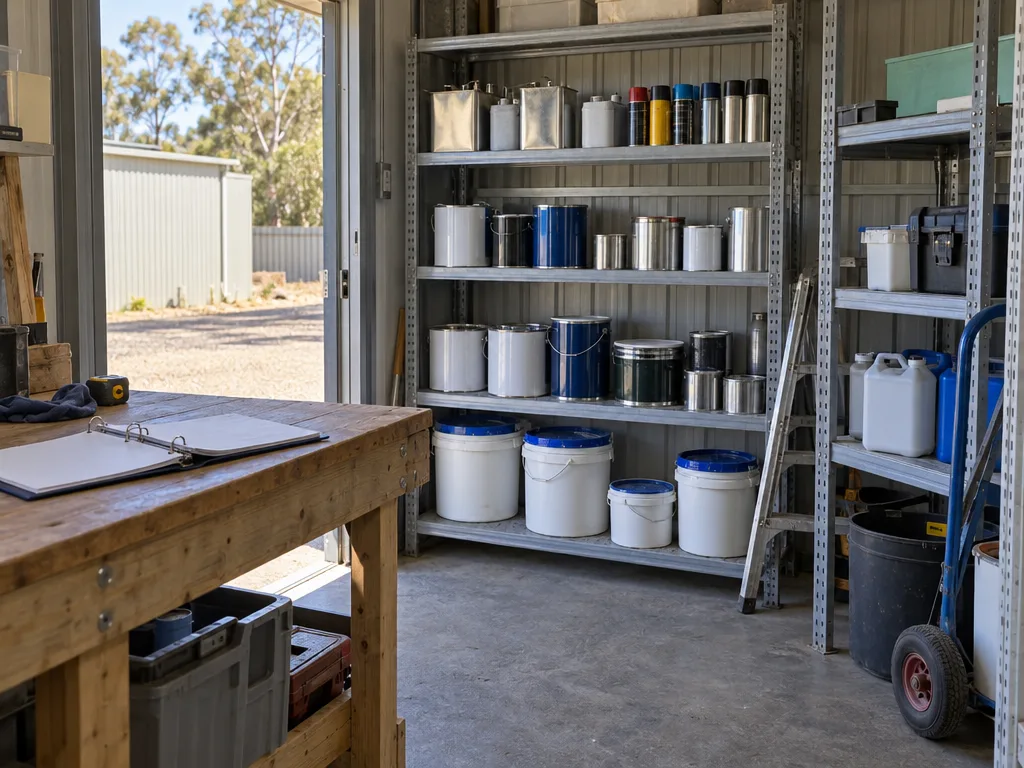
The register must list all hazardous chemicals used, stored and handled at the workplace, apart from certain consumer products and certain chemicals in transit. It must include the current SDS for each chemical listed, and everyone affected must be able to view it.
Safe Work Australia adds where it lives and who it serves. It must be kept at the workplace, readily accessible to workers and anyone likely to be affected, kept up to date, and available to workers and emergency services at any time.
In practice that means a binder or tablet near the store, not a file on the owner's laptop at home. Safe Work Australia offers a register template. It is optional, and any format that meets the requirements above will do.
Which chemicals can stay off the hazardous chemicals register?
Source: Safe Work Australia
Three groups can be left off. Safe Work Australia names them as chemicals not classified as hazardous, consumer products bought or used where no SDS is required, and hazardous chemicals "in transit and are unopened, unused and stored for 5 days or less".
The in-transit exception has a limit. Chemicals passing through may still need listing if they are in large amounts or stored frequently.
The consumer-product exception has a limit too. A household-size bottle of cleaner used the way a household would use it is one thing. The same product bought by the drum for a cleaning crew is another.
Leaving a chemical off the register does not remove your duty to tell people about it, because the register does not replace or fulfil the duty to give safety information on use, handling and storage for hazardous and non-hazardous chemicals alike.
How do you get and keep a current safety data sheet?
Source: SafeWork NSW, Safe Work Australia
Get a current SDS before you use any hazardous chemical and, where you can, when it is first supplied. When an updated SDS comes out, obtain it. Provide the information to workers, emergency services personnel or anyone who asks.
The SDS comes from the manufacturer's website, or ask the manufacturer, supplier or importer. Manufacturers and importers must check the SDS at least every 5 years. If the sheet in your binder is older than that, it is worth asking the supplier whether a newer one exists.
Some situations carry no SDS duty: chemicals in transit, a retailer supplying a consumer product without opening it on the premises, and a consumer product used in household-consistent quantities and manner. Even then, an SDS may still be offered as part of the duty to keep workers safe.
While you have the SDS binder open: Safe Work Australia says employers must keep complying with the workplace exposure standards until 1 December 2026, when workplace exposure limits replace them. That change affects airborne exposure limits only. It does not change your register, placards or storage. Pool chemical and solvent users should note that nine chemicals keep their current limits past that date pending further analysis, including chlorine, benzene and formaldehyde.
When do placards, a manifest and notification apply?
Thresholds vary by category. Check Schedule 11 of the NSW WHS Regulation 2025 for your chemical.
Source: Safe Work Australia, SafeWork NSW
These three are triggered by quantity, and the quantity depends on the chemical's category. Your SDS lists each product's hazard classification. Match that classification against Schedule 11.
A few of the thresholds in Safe Work Australia's threshold table show how wide the range is:
- Category 1 flammable liquids: placard at 50 L, manifest at 500 L.
- Category 4 flammable liquids such as diesel: placard at 10,000 L, manifest at 100,000 L.
- Category 1A skin corrosives: placard at 50 kg or L, manifest at 500 kg or L.
SafeWork NSW notes that placard quantities for flammable gases (LPG, acetylene) were cut from 500L to 200L. Industrial gases such as nitrogen, argon and oxygen sit at 1000L. Class 9 is no longer in the Schedule 11 table.
How do you count part-used tins and LPG cylinders?
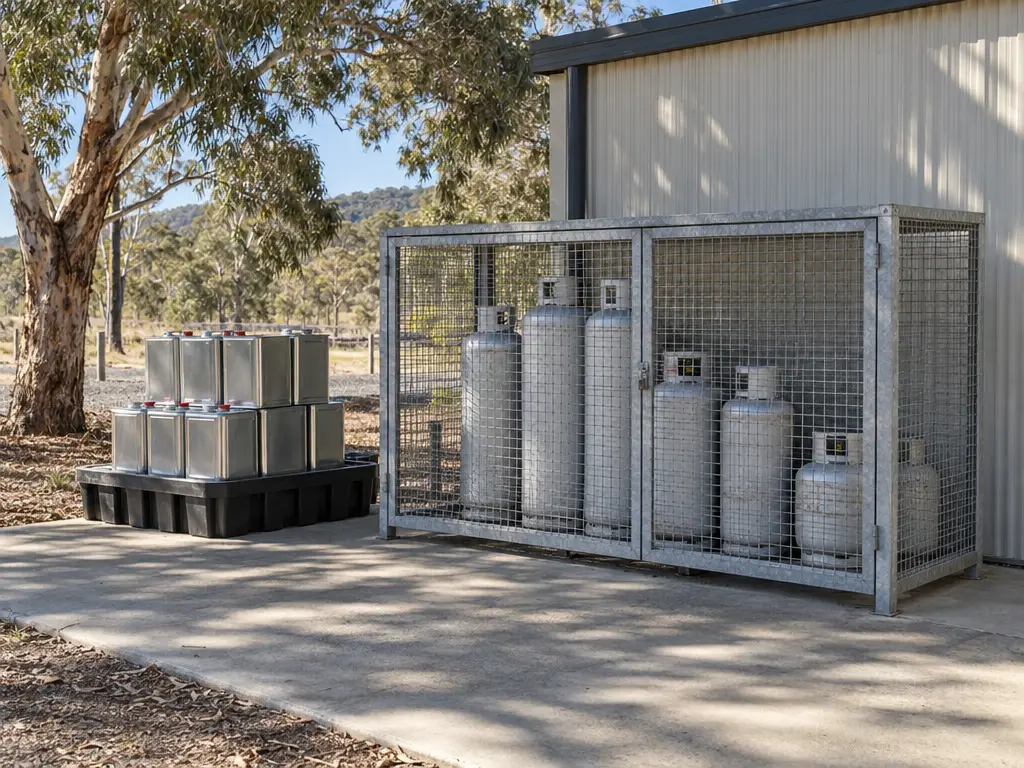
Two counting rules catch people out. First, count every package as full, even if it isn't. Second, for gas cylinders use the water capacity (the "WC" stamp), not the mass of gas inside.
Our example shows the first rule only. A store holds 60 tins of 20 L each of a Category 3 flammable liquid. That counts as 1,200 L even if half the tins are part-used, which is over the 1,000 L Category 3 placard quantity in the threshold table.
For LPG, add up the WC figures stamped on every cylinder and compare the total with the 200 L flammable gas placard quantity. Do not add up the kilograms of gas.
Where do placards go, and what does each one look like?
The path a fire crew walks from your gate to your chemicals.
- Every entrance emergency services may use: HAZCHEM outer warning placard, separate from other signs.
- Manifest at the location agreed with emergency services, marked on the site plan (only above the manifest quantity).
- Main building entry: information placard.
- Storeroom door or beside the goods: information placard with ADG Code class diamonds.
- Tank and IBC: tank placard showing shipping name, UN number, HAZCHEM code and class label.
Stops 1, 3 and 4 apply once a placard quantity is exceeded; stop 5 applies at all times unless the tank is confirmed free of hazardous chemicals. Keep every placard legible and unobstructed.
Source: SafeWork NSW, Safe Work Australia
Picture the path a fire crew walks from your gate to your chemicals. Each placard sits on that path.
At the entrance. A HAZCHEM outer warning placard is needed at the workplace entrance when a placard quantity in Schedule 11 is exceeded. The lettering is red, at least 100mm high, on white or silver. It goes at every entrance emergency services may use, separate from other signs.
At the store. Once placard quantities are exceeded, each storage area for packaged chemicals needs an information placard. It uses ADG Code class diamonds at least 100mm per side, and GHS pictograms are not used. The package placard does not need the HAZCHEM code. Indoors, information placards go at the main building entry and at each storage room entry or next to the goods.
Keep every placard legible and unobstructed. A placard behind a stacked pallet does a fire crew no good.
Which placard rules apply to tanks, IBCs, diesel and fuel retailers?
| Situation | What the placarding guide says |
|---|---|
| Tanks, including IBCs | Tank placard with shipping name, UN number, HAZCHEM code and class label at all times, unless confirmed free of hazardous chemicals. |
| Bulk | A container over 500 L or 500 kg. |
| Combustible liquids such as diesel (Category 4) | "COMBUSTIBLE LIQUID" placard, but a Class 3 label if stored with flammable liquids. |
| Fuel retailers | Exempt from the outer placard and underground flammable-liquid tank placards. The exemption does not cover LPG, or depots and distributors. |
Bulk means a container over 500L or 500kg. Tanks, including IBCs, need a tank placard showing the shipping name, UN number, HAZCHEM code and class label at all times, unless confirmed free of hazardous chemicals.
Diesel and other Category 4 combustible liquids need a "COMBUSTIBLE LIQUID" placard. If they are stored with flammable liquids, a Class 3 label is used instead.
Fuel retailers are exempt from the outer placard and from underground flammable-liquid tank placards. The exemption does not cover LPG, or depots and distributors.
What does the manifest hold, and when must you notify SafeWork NSW?
A manifest shows
Notify SafeWork NSW when
A manifest is needed only when the quantity at the workplace exceeds the Schedule 11 manifest quantity. It shows the quantity, classification and location of the chemicals, site plans and emergency contact details.
The manifest is not a bigger version of your register: it is a separate summary for emergency services, kept at a location agreed with them and shown on the site plan.
The same threshold brings in notification. If you store, handle or process Schedule 11 chemicals above the manifest quantity, you must notify SafeWork NSW. You supply a notification form, a list for each storage area, a site plan and an emergency plan lodged with Fire and Rescue NSW.
Notification is not a one-off. You also notify on a significant change in quantity, location or storage method, when you stop storing, when your contact details or ownership change, or when the acknowledgement is lost.
Labels, spill containment and health monitoring: the duties that never switch off
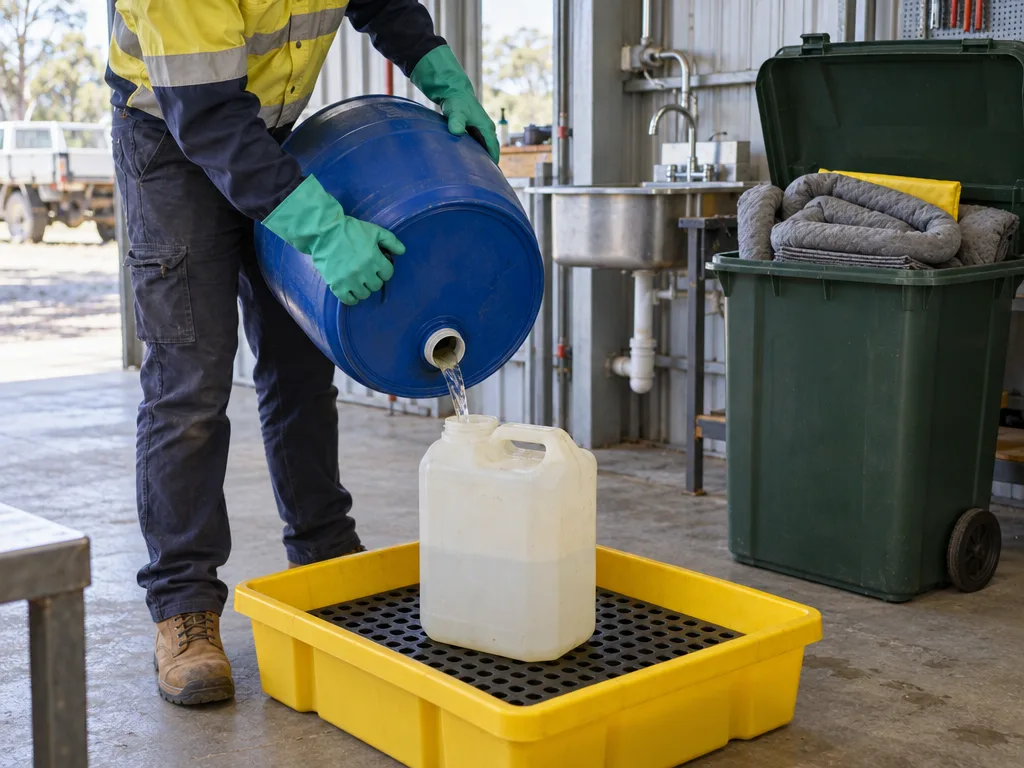
The jobs most often skipped on a small site are the ones done by hand. SafeWork NSW lists them: label decanted containers and clean emptied ones, and have spill and leak containment ready.
That pool chlorine poured into an unmarked bucket, or the solvent in a recycled drink bottle, is exactly what the labelling duty is aimed at. For what happens when a spill gets onto the road, see our guide to dangerous goods spills on the road.
Workers regularly exposed to certain chemicals may need health monitoring, and those records are kept for 30 years.
What changed with the WHS Regulation 2025?
Source: SafeWork NSW, Safe Work Australia
The WHS Regulation 2025 commenced on 22 August 2025. Workplaces holding 25,000kg or more of lithium batteries must now lodge an emergency plan with Fire and Rescue NSW. The same SafeWork NSW page lists a new duty to comply with approved codes of practice from 1 July 2026.
The codes SafeWork NSW cites for hazardous chemicals cover managing risks, labelling and preparing SDS. They are worth a read if you are setting up a store for the first time.
The key figures in one view
Source: Safe Work Australia, SafeWork NSW
These are the fixed numbers worth keeping on the wall of the store. The in-transit window is 5 days or less. Manufacturers and importers check the SDS at least every 5 years. Bulk means over 500L or 500kg, and HAZCHEM lettering and class diamonds are at least 100mm. Health monitoring records are kept 30 years. The placard and manifest quantities themselves depend on your chemical's category, so check those against Schedule 11 every time.
Does a dangerous goods licence cover any of this?
No. The register, SDS, placards, manifest and notification are workplace storage duties under the WHS Regulation. A dangerous goods licence is about moving goods by road. Our page on the driver licence and vehicle licence explains that side. Holding a driver licence, or sending staff through an awareness course, does not meet any of the storage duties above.
Your next step is to walk your own store with the SDS binder in hand. Check each chemical's category, count every container as full, and compare the totals with Schedule 11. Where a question is about your particular site, SafeWork NSW's general requirements page is the place to start.
If your team also loads, carts or receives dangerous goods, our comparison of licence and awareness courses sets out the options. To talk through which training fits your people, send Dangerous Goods Licence Newcastle a message through our contact page.
Sources
- https://www.safework.nsw.gov.au/hazards-a-z/hazardous-chemical/general-requirements
- https://www.safework.nsw.gov.au/hazards-a-z/hazardous-chemical/general-requirements/general-requirements-accordion/keep-a-register
- https://www.safeworkaustralia.gov.au/safety-topic/hazards/chemicals/hazardous-chemical-records-and-signs-workplaces/hazardous-chemicals-register
- https://www.safeworkaustralia.gov.au/safety-topic/hazards/chemicals/safety-data-sheets/using-safety-data-sheets
- https://www.safeworkaustralia.gov.au/media-centre/news/new-workplace-exposure-limits-wel-apply-1-december-2026
- https://www.safeworkaustralia.gov.au/safety-topic/hazards/chemicals/hazardous-chemical-records-and-signs-workplaces/placard-and-manifest-threshold-quantities
- https://www.safework.nsw.gov.au/resource-library/hazardous-chemicals/placarding-for-storage-of-hazardous-chemicals
- https://www.safeworkaustralia.gov.au/safety-topic/hazards/chemicals/hazardous-chemical-records-and-signs-workplaces/manifest-requirements-hazardous-chemicals
- https://www.safework.nsw.gov.au/notify-safework/dangerous-goods-notifications
- https://www.safework.nsw.gov.au/legal-obligations/legislation
Pictures in this guide are illustrations, not photos of our jobs.
Build the right foundations
Ask about dangerous goods training in Newcastle for you or your team.